
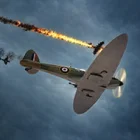
Sky on Fire 1940
Play Sky on Fire 1940, a accessible single-player WWII flight sim game, free in your browser. Controls: Mouse and keyboard, gamepad, HOTAS, TrackIR.
You may like










How realistic can a flight sim be while still promising that you will not need a manual to take off? Sky on Fire 1940 answers by keeping the physics honest, trimming the busywork, and then dropping you into a bomber whose rear gunner may or may not be a better shot than you.
| Genre | Accessible single-player WWII flight sim |
| Theater | Western Europe in 1940, plus a 1944 extension |
| Aircraft | 18 planes in the 1940 roster |
| Ways to play | Quick missions, linear campaigns, dynamic campaign, Workshop missions |
| Controls | Mouse and keyboard, gamepad, HOTAS, TrackIR |
What Sky on Fire 1940 Keeps and What It Cuts
The game follows what it calls the accessible sim approach: anything that changes how a plane flies or fights stays, and anything that only adds reading or workload goes. You still get airfoil-based physics, so handling and energy management feel authentic, plus engine power levels and supercharger behavior that follow the real machines. The damage model is built from modules, so a round that clips a wing does something very different from one that finds the engine.
Beginners tend to fight the airplane instead of managing its energy. A hard turn in a Hurricane Mk.I bleeds speed fast.
That balance is also what divides players. Some veterans call the result a flight sim lite, and hardcore fans who want every switch modeled may find the cockpit workload too gentle, while players on a gamepad praise how quickly they can get into a dogfight. A rebinding system with axes, a curve editor, and toggle or hold buttons helps both camps meet in the middle.
Spitfire Mk.I, Bf 109 E-4, and the 1940 Roster
The 1940 roster holds 18 aircraft from the western European theater, led by the Spitfire Mk.I, Hurricane Mk.I, Bf 109 E-4, He 111 H, and Dewoitine D.520. Less famous machines such as the Boulton Paul Defiant and the Morane-Saulnier 406 fill the gaps, and they are where history buffs spend their first evenings. Early in the game these planes define every fight, because everyone is flying the same generation of technology.
The 1944 extension changes the mood completely. Late-war machines like the Bf 109 G-14, Fw 190 A-8, Spitfire Mk.IX, P-47D, P-51D, and P-38L arrive with a very different sense of power.
Each airframe handles differently enough that a Spitfire Mk.I pilot has to rethink climb, turn, and engine management in a Bf 109 E-4. Players who like learning one plane deeply will enjoy that, since the supercharger and power modeling reward patience over button mashing. Switching sides is the fastest way to understand why pilots in 1940 argued so much about which fighter was better.
Crew Seats: Gunners, Bombardiers, and Torpedo Runs
What separates the game from a typical fighter sim is that you can take control of any crew member in your aircraft, including the bombardier and the defensive gunners. When you fly as the pilot, the gunners operate on their own, and the computer does a decent job, though a human aimer can still do better. Community advice says the function keys cycle between pilot and gunner positions on certain planes, which matters the first time an He 111 H gets a fighter on its tail.
Torpedo runs against ship convoys are the riskiest job on the list. Intercepting large bomber formations is the busiest.
Fighter pilots chasing a bomber formation learn quickly that every defensive gun covers its own arc, so the approach angle matters as much as the shot itself. Players who prefer the bomber seat get a different kind of tension, since they spend their sorties watching the sky and trusting a crew. Airfield assaults and strategic targets round out the mission types for anyone who wants to drop bombs instead of chasing kills.
Four Ways to Play and the Mission Editor in Sky on Fire 1940
The game offers four distinct modes: quick missions you can set up instantly, linear campaigns that follow historical events and real squadrons, a dynamic campaign where your results influence a much larger simulated conflict, and user-made missions and campaigns on the Steam Workshop. Newcomers should start with quick missions to practice landings and gun work before committing to a campaign. Completionists will gravitate toward the dynamic campaign, since nothing else in the game ties results together so directly.
The mission editor is the sleeper feature. It lets you create your own scenarios, and community mods and liveries show how far it can stretch.
Two caveats keep the game honest. It is strictly single-player, so anyone hoping for squadron play with friends will not find it here, and the stylized visuals will not satisfy players who want photorealism, though the physics underneath are what most fans talk about.
Sky on Fire 1940 is at its best when you pick one plane and learn it properly: take a Spitfire Mk.I up against a Bf 109 E-4, trade height for speed, and then swap into the gun seat of an He 111 H to see what the other side is dealing with. The accessible rules make that loop approachable, and the mission editor keeps it going long after the quick missions run dry.
Other Shooting Scratch Games You May Like
If Sky on Fire 1940 clicked with you, try one of these next:
Player Reviews
There are no reviews yet. Be the first one to write one.