

Beach Volleyball
Play Beach Volleyball, a arcade sports Scratch game, free in your browser. No download, no sign-up.
You may like



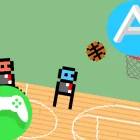



















In Beach Volleyball you start on your side of the net with the ball about to drop toward the sand, which matters because the first touch decides most rallies. There is no passing system or complicated rotation to manage. Your player moves, jumps, and meets the ball with his body, and the angle of that contact sends it back across.
| Genre | Arcade sports |
| Format | One side versus one side across a net |
| Core actions | Move and jump |
| Goal | Make the ball land on the opponent’s side of the sand |
How Contact Angles Work in Beach Volleyball
The ball bounces off your player according to where it hits. Contact on the front of the body sends it forward and low, while contact on the top sends it high and soft. Positioning under the ball, not chasing it, is what controls the return.
Beginners run straight at the ball. That usually produces a weak bounce into the net.
Standing slightly behind the landing point and moving forward into the ball gives the forward push that clears the net with room to spare. Players who enjoy physics-based sports pick this up fast and start aiming returns within a few rallies.
Jump Timing at the Net
Jumping turns a defensive touch into an attack. Meeting the ball high near the net lets you push it down steeply into the opponent’s sand, which is the closest thing the game has to a spike. Jump too early and the ball sails over your head; jump too late and it hits your body on the way down.
The right moment is usually when the ball starts falling, not when it is still rising. Watching the top of its arc is the easiest cue.
That timing takes a few matches to feel natural. Once it does, rallies get much shorter, because a well-timed jump at the net ends points that used to drag on.
Reading the Opponent’s Returns
Every return reveals where the next one is heading. A ball that comes over high and slow gives time to set up, while a fast low one demands an immediate move. Watching the opponent’s position at contact tells you which to expect before the ball crosses the net.
Defensive players love this part of the game. They win by reaching everything rather than by smashing winners.
Against a partner on the same keyboard, these reads turn matches into small mind games, with each side trying to send the ball where the other is not standing. The soft thud of the ball hitting the sand right behind a frozen opponent is the most satisfying sound in the match.
Techniques Regulars Use
Some habits come up again and again in comments from players who have spent time with the game. They are not hidden tricks, just consistent ways of handling the ball and the sand.
Back step. Move slightly behind the ball before it lands so your forward motion adds power to the return. Net hover. Stay close to the net after attacking to block quick returns. Corner shot. Aim for the back corners of the opponent’s side, where the ball is hardest to reach in time.
These three cover most situations, and combining them makes even simple controls feel tactical. Most long rallies are decided by whoever uses the back step more consistently.
What Beach Volleyball Gets Right and Wrong
The simple controls make the game easy to pick up for anyone, including younger players. A match can start in seconds without any learning curve beyond movement and jumping.
The downside is depth. After many matches, rallies can start to feel similar.
Some players also find the bounce physics unpredictable when the ball hits the edge of the body, while others enjoy that slight randomness. It keeps rallies from becoming completely mechanical.
Beach Volleyball comes down to standing behind the ball instead of chasing it, jumping as it starts to fall near the net, and aiming for the back corners of the sand. Get those three habits working and rallies swing in your favor far more often.
Other Sports Scratch Games You May Like
If Beach Volleyball clicked with you, try one of these next:



Player Reviews
There are no reviews yet. Be the first one to write one.