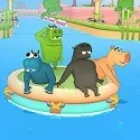
Fart Together
Play Fart Together, a physics-based co-op obstacle course, party game game, free in your browser. Controls: Keyboard, Xbox and DualSense controllers.
You may like



















You lean your hippo toward the left edge of the raft, let out a long burst, and watch the whole crew spin a full half-circle because your friend on the opposite side fired at the exact same moment. That is the first lesson of Fart Together: the raft does not care who meant well, only where the force came from and when it arrived. Every hippo on board shares one vessel, so a single gas burst changes the course for everyone, and the run lives or dies on timing rather than raw power.
| Genre | Physics-based co-op obstacle course, party game |
| Players | 2–4 in co-op; Team Race planned for up to 8 |
| Platform | PC |
| Crew | Hippos sharing a single raft |
| Controls | Keyboard, Xbox and DualSense controllers |
| Co-op options | Network co-op, local co-op on one PC |
The Shared Raft and How the Hippos Push It
Each player controls one hippo standing on the raft, and each hippo produces thrust by farting in the direction it faces. Where your hippo stands matters as much as when you fire. A burst from the back pushes the raft forward in a fairly straight line, while a burst from a corner adds rotation, and two corner bursts from opposite sides can cancel each other out or send the raft into a lazy spiral. Once you understand that the raft is a single physics body reacting to the force, direction and timing of every hippo at once, the chaos starts to look less random.
The game rewards thinking of the raft as a rudder problem rather than a race. Small, staggered bursts keep the heading stable, and a well-placed nudge from one hippo is often worth more than three players spamming at full strength.
Three things decide where the raft actually goes after a burst:
- Position of the hippo on the deck — edges create spin, the stern creates forward drive
- Timing relative to teammates — simultaneous bursts stack, staggered ones steer
- Gas strength — longer bursts carry more momentum, which is harder to stop before a wall
Why Farting Harder Ruins Runs in Fart Together
New crews almost always hold the button down. It feels logical: more gas, more speed, faster finish. In practice the raft builds momentum it cannot shed, overshoots the next turn, and slams sideways into whatever hazard sits beyond it. The tagline about farting together at the right time rather than farting harder is not just a joke on the store page; it is the most accurate tip anyone can give about Fart Together.
The second beginner mistake is overcorrecting. Someone sees the raft drifting right, fires hard from the right edge, and a teammate does the same half a second later. Now the raft drifts left twice as fast. Players call this “ping-ponging”, and early in the game it accounts for more failed attempts than any obstacle on the course.
The fix is boring but effective: assign one hippo to forward drive and let the others handle corrections in short taps. Methodical players who like puzzle-style planning tend to settle into the steering role naturally, while the most impatient member of the group is usually happiest as the engine at the back.
Calling Shots: Voice Chat That Keeps the Crew Straight
Coordination in Fart Together lives in voice chat. Groups that play in silence spend most of their time fishing the raft back onto the route, while groups that call each burst out loud start clearing sections cleanly within a few attempts. The phrase “What did I do?” turns up so often that the store page itself jokes about it, and anyone who has played a session knows exactly the tone in which it gets said.
A short shared vocabulary helps far more than detailed plans. Directional calls based on the raft’s own orientation, rather than the screen, remove a lot of confusion once the camera angle shifts during a turn.
A calling routine that works for most crews:
- One player is the caller and announces turns before the raft reaches them
- The caller counts down simultaneous bursts — “three, two, go” — for straightaways
- Steering hippos confirm with a single word before tapping, so two corrections never overlap
- After a crash, the group agrees on who fires first on the restart instead of everyone launching at once
Narrow Passages, Sharp Turns and Moving Hazards
The opening stretch of a course is forgiving: wide water, gentle bends, room to wobble. That is where crews learn how much rotation a single corner burst produces. By the time the raft reaches the first narrow passage, the margin shrinks to roughly the width of the raft itself, and a sloppy approach angle means scraping along the walls until the momentum dies.
Sharp turns are the real skill check. The approach that works is to slow down before the bend with a short counter-burst from the front, rotate with one corner hippo, then let the stern hippo drive out of the turn. Trying to turn and accelerate at the same time is how rafts end up pinned against the outside wall.
Moving obstacles add a timing layer on top of steering. Instead of rushing through, experienced crews hold the raft nearly still in front of the hazard, watch one full cycle, and only then commit with a coordinated burst. Players who enjoy precision platformers will recognise the rhythm immediately; it is the same patience, just shared among four hippos who may not agree on when the gap is open.
Where Fart Together Frustrates Groups
The physics are, by the game’s own admission, only sort of realistic. Most of the time that unpredictability is the comedy, but occasionally the raft reacts in a way nobody can explain, and a run that looked perfect collapses because of a bounce off a wall corner. Some players love those moments as clip material; others find that random failure undermines the sense that skill is what moves the crew forward.
There is also the friendship question. The game openly warns that it may test friendships, and it is not exaggerating. Because every mistake is shared, it is very easy to blame the person whose hippo fired last, even when the real problem was a bad approach angle two seconds earlier.
Mixed-skill groups feel this most sharply. A crew of four is only as steady as its least coordinated hippo, and patient players can burn out repeating the same section with someone who keeps holding the button. Casual groups looking for a party game for a single evening tend to enjoy that mess, while players who want steady progression may find the restart loop wearing after an hour.
Team Race and the Road Through Early Access
The current build of Fart Together focuses on the co-op obstacle course for 2 to 4 players. Team Race, the competitive mode in which up to 8 players split into crews and race on the same course, is still in development and is not part of the current version. That matters if you are buying mainly for competitive play with a larger group.
The plans for the full version include more courses, more obstacles, extra modes, new characters and customization options, along with balance and polish work. Right now, the hippos are the only crew on board, so variety comes from the courses and from your friends rather than from unlockables.
Community feedback through discussion boards and Discord is meant to shape how difficulty and controls are tuned. For now, the core loop of steering one shared raft is solid enough to carry a session, but anyone expecting a large content library should treat the current build as a foundation rather than a finished package.
Questions Crews Ask Before Boarding
How many players does Fart Together support?
The co-op obstacle course is built for 2 to 4 players, each controlling one hippo on the same raft. Team Race is designed for up to 8 players split into competing crews, but that mode is still being developed. Local co-op on a single PC is supported alongside network co-op.
Can you play with a controller?
Yes, Xbox controllers and PlayStation DualSense controllers are supported. Many crews find analog sticks easier for aiming a hippo toward a raft corner and feathering short bursts during tight turns. Keyboard works, but quick taps for corrections feel more natural on a pad.
Is Fart Together fun with only two players?
With two hippos the raft is easier to coordinate, because there are fewer overlapping bursts and the caller role is obvious. The trade-off is that one player has to handle both forward drive and steering in tight sections, which makes sharp turns and moving obstacles noticeably harder. Four-hippo crews are louder and messier but can split duties between drive and correction.
Fart Together works best when a crew stops treating gas as a speed button and starts treating the raft as something four hippos steer with small, agreed-upon bursts. Learn which deck position adds spin, let one caller set the rhythm through narrow passages, and save the full-strength blasts for straightaways. Once Team Race arrives, that same discipline will decide which crew crosses the line first.
Explore More New Games
Enjoyed Fart Together? These picks from the same genre are a good next step:
Other Scratch Games to Try
Player Reviews
There are no reviews yet. Be the first one to write one.