
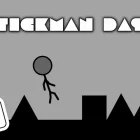
Stickman Dash
Play Stickman Dash, a action runner Scratch game, free in your browser. No download, no sign-up.
You may like










In Stickman Dash you start already sprinting with a jump and a dash at your disposal, which matters because the first obstacle arrives before you have time to settle in. There is no warm-up corridor and no tutorial screen. The game expects you to learn the difference between the two moves by using them, and it shows you the result of a wrong choice immediately.
| Genre | Action runner |
| Core moves | Jump and dash |
| Goal | Reach the end of each run without crashing |
| Fail state | Collision with an obstacle or a missed landing |
Jump Versus Dash in Stickman Dash
The jump lifts the stickman over low obstacles, while the dash launches him forward in a quick burst. New players treat them as interchangeable and lose runs because of it. A dash used in front of a tall wall sends the figure straight into it, and a jump used over a long gap often falls short because it does not add any forward distance.
Think of the jump as vertical and the dash as horizontal. That simple split clears up most early mistakes.
The real skill comes from combining them. Jumping first and dashing at the top of the arc carries the stickman across gaps that neither move could clear on its own, and players call this the jump-dash. It is the single most important technique in the game, and the later sections are built around it.
Timing the dash too early in the jump flattens the arc and drops the figure into the gap anyway. Waiting for the peak, when the stickman seems to hang in the air for a moment, gives the longest possible reach.
How Difficulty Builds Through a Run
Early in the game the obstacles come one at a time, with plenty of space to react. Once tall walls start appearing next to wide gaps, you have to choose between jump and dash in a fraction of a second, and hesitation becomes the main cause of failure. Speedrunners love this stretch because a clean read of the course lets them chain jump-dashes without breaking stride.
The pace never really drops. Even a short pause to think usually means the next obstacle is already on top of you.
- Clear single obstacles with the matching move: jump for low blocks, dash for short gaps.
- Practice the jump-dash on easy gaps until the timing at the peak feels natural.
- Read pairs of obstacles together instead of reacting to each one separately.
- Save the dash when you are unsure, because a wasted dash leaves you with only the jump.
Some players feel the game is too unforgiving, since one wrong input ends the run and there is no health bar to absorb mistakes. That criticism is fair, and casual players who prefer a gentler curve may find the later stretches more stressful than fun.
The other side of the argument is that every failure is readable. You always know which input was wrong, which makes each retry feel like progress rather than punishment.
Stickman Dash Questions Players Search For
How do you cross the longest gaps in Stickman Dash?
Use the jump-dash: jump first, then dash at the very top of the arc. Dashing from the ground or early in the jump flattens the path, while dashing at the peak keeps the height and adds the forward burst on top of it.
Why does the stickman crash into walls after dashing?
The dash only moves him forward, so it cannot lift him over anything tall. Walls need a jump, and if a wall sits right after a gap, jump first and save the dash for the space behind it.
Is it worth holding the dash in reserve?
Yes, especially in sections where walls and gaps alternate quickly. Spending the dash on a gap that a normal jump could clear leaves the stickman without his longest move when a wide gap appears next.
Stickman Dash clicks once the jump and the dash stop feeling like two buttons and start feeling like one motion, with the dash landing right at the peak of the arc. Master that jump-dash early, and the wall-and-gap sections later in each run become the most satisfying part instead of the most frustrating one.
Explore More Stickman Scratch Games
If Stickman Dash clicked with you, try one of these next:
Other Scratch Games to Try


Player Reviews
There are no reviews yet. Be the first one to write one.